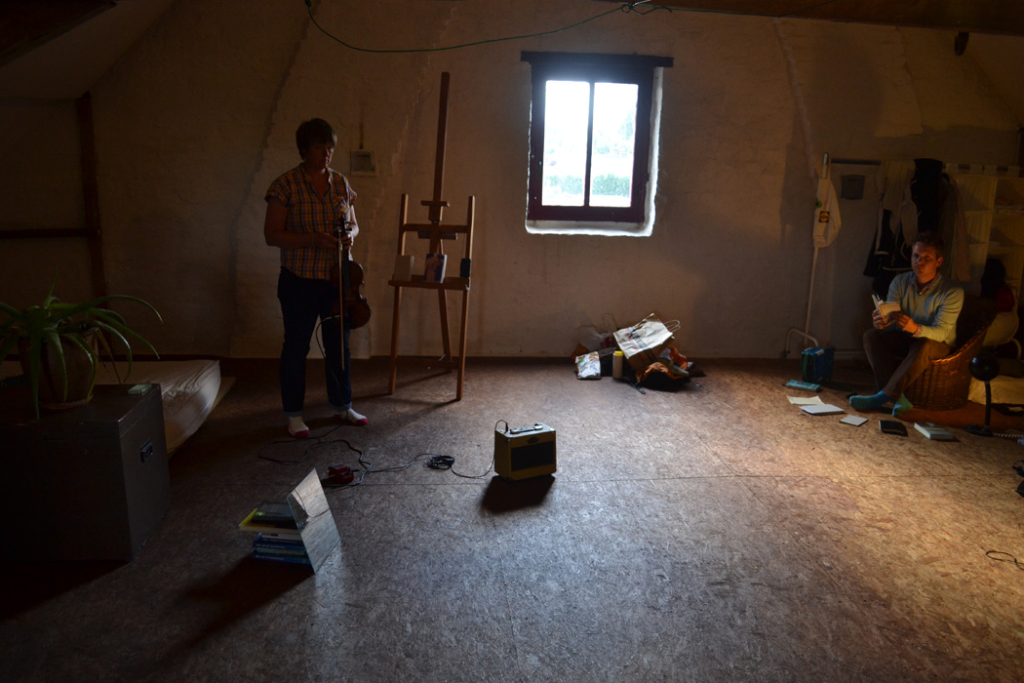
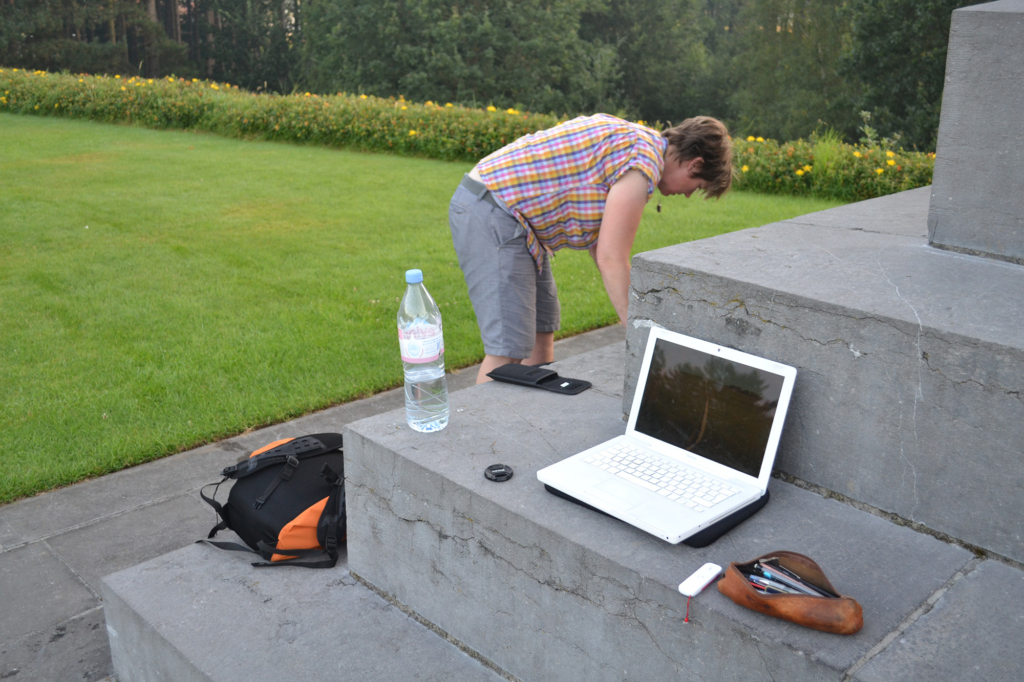
A Belgian Transect was a series of Field Broadcasts produced by Eleanor Wynne Davis and myself in 2012 as part Sideways Festival4. Over the period of a month commissioned artists and members of the public traversed a 400km line from West to East across Belgium. The thirteen broadcasts were the first time this technology had been used over a given period in this manner. This field report aims to introduce what we learnt through that process, and through this set out the technologies potential to arts practices that are of an ecological disposition.
Davis and I met whilst studying for an MA in Arts & Ecology run collaboratively by Dartington College of Arts and Schumacher School of Holistic Science5. In his work The three ecologies Guatarri (2005) expands the scope of ecology to encompass the whole breadth of human endeavor, and so by ecological in the above paragraph I do not intend to refer to arts that deal with the ‘land & environment’ as set out by Kastner&Wallis (1998), but to practice that is open to the notion “no discourse is truly objective” (Morton 2013, 4). Here the term “ecology must stop being associated with the image of a small nature-loving minority or with qualified specialists” (Guattari 2005, 52), for here I intend ecology to be “a vast, sprawling mesh of interconnection without a definite center [sp] or edge” of which we are all a part (Morton 2012, 8). Ecology is the study of a natural system and what is humanity but a natural system fuelled by hidden connections, immense in its complexity. It is from traditional ecology however, that I have built upon the notion of a transect, where ‘transect’ is taken to mean: “A line used […] to provide a means of measuring and representing graphically the distribution of organisms” (Allaby 2004, 409). In this paper, the scale of the line is expanded to that of a distance walked across a given area, in this case Belgium, the samples then taken in this transect measure a culture and the interplay between two selves, Davis and I, within that culture. Thereby constructing a transect, a line “in a sense that is more visionary or metaphysical” than the physical presence of a length of string across a field in as in ecology fieldwork (Ingold 2007, 47). It is a line drawn first on a map, then walked, talked and performed into being by, in this case, the participants, coordinators and audience members of Sideways festival.